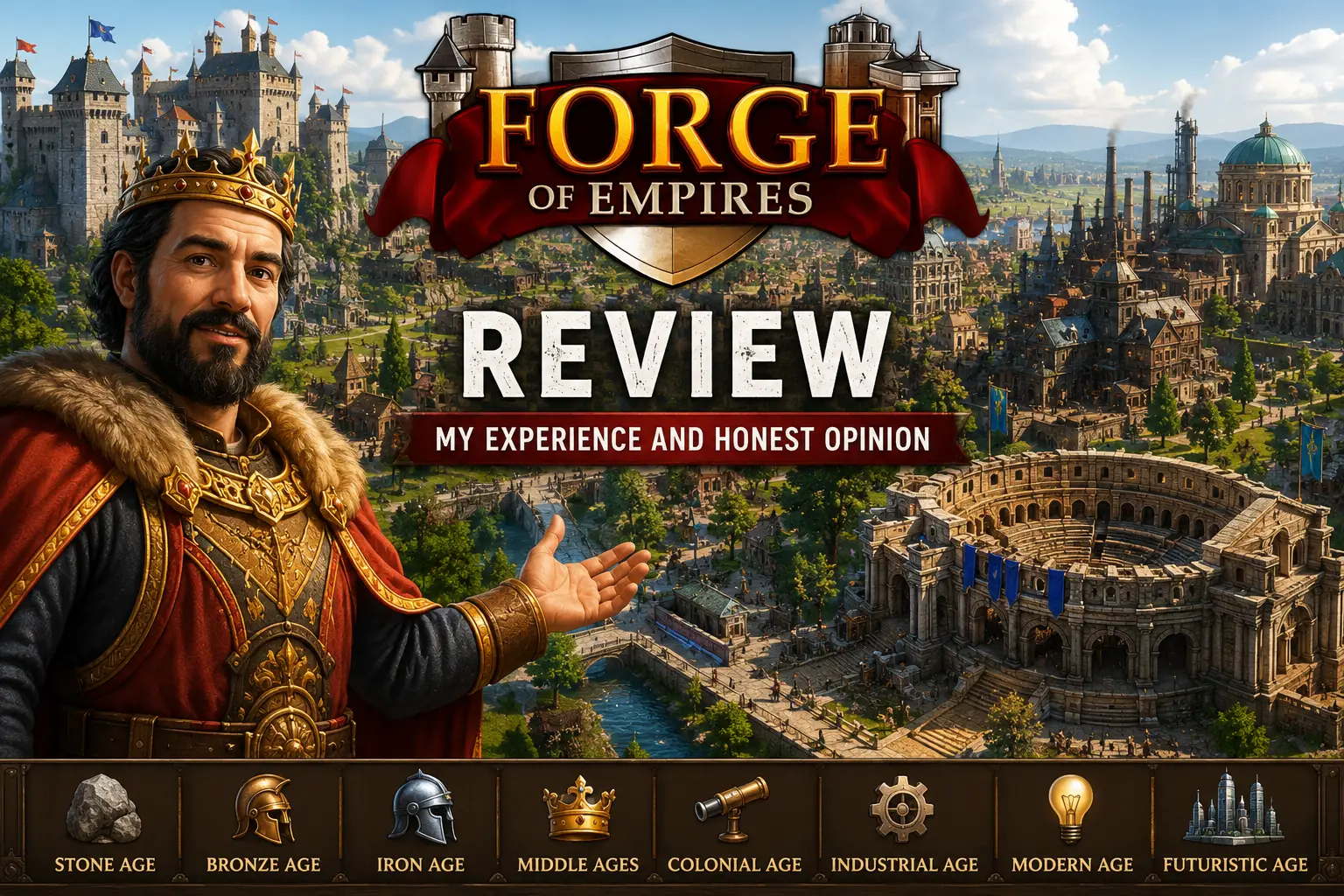
Forge of Empires Review
I still remember the evening I stumbled across Forge of Empires while scrolling through browser game recommendations. I wasn’t really looking for anything specific – just a bit of entertainment after a long day. But once I clicked on that first link and the loading screen appeared, I didn’t move from my desk for about three hours. That night told me everything I needed to know: Forge of Empires was not your average city-building game.
In this review, I’m going to share everything I personally experienced while playing Forge of Empires – the good stuff, the annoying parts, the little surprises, and whether I think it’s genuinely worth your time. I played this game daily for over a week before sitting down to write this, so everything here comes from firsthand experience, not just surface-level observations.
Forge of Empires Beginner Guide – Things I Wish I Knew Earlier
My First Impression of Forge of Empires
When I first tried Forge of Empires, I honestly expected something simple. A few buildings, some resources, maybe a tiny battle here and there. I was wrong – pleasantly wrong. The moment the game loaded in my browser, I was greeted with a polished interface, a friendly tutorial guide named Aide, and a Stone Age village that was mine to develop.
The tutorial did a solid job of walking me through the basics without being too hand-holdy. Within the first fifteen minutes, I had my first residential building up, my first supply building running, and I’d fought my first battle on the campaign map. The pacing felt right. Not too rushed, not too slow.
What really grabbed me was the historical progression angle. Forge of Empires lets you start from prehistoric times and slowly advance through different historical eras – the Iron Age, the Early Middle Ages, the High Middle Ages, and so on. That sense of actually building a civilization through time? It hooked me immediately.
My Gameplay Experience with Forge of Empires
After spending a few days testing the game, I started to get a deeper feel for the mechanics. Forge of Empires is essentially a strategy game at its core, but it wears many hats. You’re managing a city, planning building layouts, gathering resources, researching technologies, and sending troops into turn-based battles. There’s a lot going on, but it never felt overwhelming.
The strategy gameplay is genuinely enjoyable. Every decision you make – which building to place, which technology to research next, whether to attack or negotiate – has consequences. I found myself planning my moves carefully, especially in the mid-game when resources become tighter.
Graphics and Interface
The visual design in Forge of Empires is one of its biggest strengths. For a browser-based game, the graphics are surprisingly detailed. Buildings look distinct across different eras. Your Stone Age huts look nothing like your Medieval workshops, and that visual evolution genuinely makes you feel like you’re progressing.
The interface is clean and intuitive. The resource bar at the top always keeps you informed, and the menus are logically organized. I personally liked that I could access everything I needed within a few clicks. On mobile, the experience was similarly smooth – Forge of Empires mobile experience impressed me more than I expected, with touch controls feeling natural and responsive.
One thing I especially appreciated was the visual feedback during battles. Watching your units move across the hexagonal grid and strike at enemies feels satisfying – there’s weight to each move. It doesn’t look like some generic flash game. It looks like a game someone actually cared about making.
City-Building System
If there’s one part of Forge of Empires that I found genuinely addictive, it’s the city-building system. Managing space is one of the main challenges. Your land is limited, and every building takes up a specific footprint. You have to balance residential buildings (for population), supply buildings (for goods), military buildings, decorations that boost happiness, and special buildings from events.
I spent way too much time re-arranging my city layout trying to maximize efficiency. There’s a certain satisfaction in figuring out the perfect configuration. In my experience, this is where Forge of Empires really shines compared to other city-building games. The spatial puzzle element adds a layer of depth that keeps you engaged even when you’re not actively progressing.
Empire progression feels organic too. You don’t just unlock new buildings by paying – you research them through a technology tree. That small distinction makes advancement feel earned rather than purchased.
Features I Personally Liked About Forge of Empires
Let me be direct: there’s a lot to love about Forge of Empires gameplay when you give it a proper chance. Here are the things that genuinely stood out to me during my testing period.
The Great Buildings system blew me away. These are special landmark structures you can construct using blueprints contributed by other players. They provide powerful bonuses and become the cornerstone of your long-term strategy. It’s also a social mechanic that rewards helping other players, which I found surprisingly wholesome for a competitive game.
The Guild system adds a whole layer of community and cooperation. Joining a Guild lets you participate in Guild Expeditions and Guild Battlegrounds, both of which offer exciting rewards. I personally liked how Forge of Empires made teamwork feel genuinely useful rather than just cosmetic.
Seasonal events in Forge of Empires are another highlight. The game regularly runs themed events – a Winter event, a Spring event, a Summer event – each with unique quests, exclusive buildings, and rewards. These events kept me coming back every day and broke the monotony that long strategy games can sometimes develop.
The Battle System in Detail
The battle system deserves its own mention. Forge of Empires uses a turn-based hex grid combat system where unit positioning, terrain, and unit type all matter. You can have up to eight units per fight, and each unit has strengths and weaknesses against others. Rangers beat cavalry. Cannons wreck heavy infantry. There’s genuine strategic depth here.
If you don’t want to fight manually, you can auto-battle, but I always felt I got better results by taking control. That’s a nice balance – giving casual players an easy option while still rewarding skill for those who want to dig deeper.
Things I Didn’t Like Much About Forge of Empires
I want to be honest here because no game is perfect, and Forge of Empires has its share of frustrations. The biggest one for me is the energy and timing system. Some buildings take hours to produce goods, and in the early game that waiting can feel like a wall. I get why it’s there – it’s a free-to-play game and they need monetization. But it did test my patience more than once.
The premium currency (Diamonds) is everywhere. Want to rush a building? Diamonds. Want special event buildings? Diamonds. The game never forces you to spend real money, and I played for a full week without paying anything. But the prompts are frequent enough to be slightly annoying.
Also, the learning curve is steeper than the tutorial suggests. Once you get past the first few eras, you realize how much depth there actually is – goods trading, forge points, negotiation mechanics, GvG maps. It’s a lot to absorb, and the game doesn’t always explain things clearly.
[H5] Advice for Beginners Just Starting Forge of Empires
If you’re new to Forge of Empires, here’s what I wish someone had told me on day one. First, don’t rush your era progression. It’s tempting to advance to the next age as fast as possible, but the players who thrive are those who fully develop their current era before moving on. Max out your technologies, stockpile goods, and build a strong economy before advancing.
Second, join a Guild early. Even a small, casual Guild will help you enormously – Guild members aid each other’s buildings, which boosts production. It’s free, social, and genuinely impactful.
Third, take your Great Buildings seriously. The moment blueprints start appearing, start planning which Great Building you want first. Most experienced players recommend the Hagia Sophia or Notre Dame as early priorities because of their happiness bonuses. Trust the process and you’ll see the difference in your city’s growth.
Is Forge of Empires Worth Playing?
Short answer: yes. But let me explain why.
Forge of Empires is one of those rare free-to-play games that genuinely rewards patience and strategy over spending money. After spending a full week testing the game, I came away impressed. The depth is real. The community is active. The content updates regularly. And crucially, you can make serious progress without touching your wallet.
Is it perfect? No. The waiting mechanics can frustrate you. The premium currency is omnipresent. And it does take real time investment to get into the deeper content. But if you’re looking for a strategy game you can pick up in the morning, progress over lunch, and come back to in the evening, Forge of Empires fits that lifestyle perfectly.
Compared to other city-building games in the same space, Forge of Empires holds up extremely well. The historical era progression is unique. The battle system has more depth than most casual games dare to include. And the social elements – Guilds, Great Buildings, player trading – give the whole experience a living, breathing quality that single-player games can’t replicate.
Final Thoughts: A Strategy Game Built to Last
Forge of Empires has been around since 2012, and it’s still going strong. That longevity isn’t an accident – it’s the result of a game that respects its players’ intelligence, keeps evolving its content, and has built a loyal global community. Not many browser games survive over a decade without becoming hollow cash grabs. Forge of Empires managed it.
If you’re on the fence, just try it. It’s free, it runs in your browser or on your phone, and you’ll know within the first hour whether it’s your kind of game. Based on my experience, there’s a good chance it will be.